Your father calls every Sunday at eleven his time. You already know how this goes, because it has gone the same way for years. "Bueno." "Hola, Papá." "¿Cómo estás?" "Bien, bien, ¿y tú?" "Bien, bien." A pause you have both learned to expect. "¿Y los niños?" "Bien, comiendo mucho." Another pause, and then, almost in unison, a small laugh at nothing in particular. "Bueno... te quiero, hijo." "Yo también, Papá." The call ends at one minute fifty, the same as last Sunday, the same as the Sunday before that. Nothing was really said. Everything that could be said, in the ten phrases you both fully trust, was.
This is the call that happens between the big calls - not the birthday video chat with the whole family crowded around a laptop, not the holiday check-in with translated captions running underneath everyone's face. Just an ordinary Tuesday or Sunday, a plain voice call, the same phrases cycling through in the same order, because those are the only phrases either of you is certain will not be misunderstood.
The phone call, translated
A video call with live translated captions is one shape of this problem - the big, occasional, whole-family moment. This is the smaller one. No camera, no laptop propped against the fruit bowl, often no great signal for video anyway - just a call, the way phone calls have always worked, made constantly and forgotten quickly because there is rarely anything remarkable in them. That is exactly why they matter: they are the most frequent contact most families actually have, and the one nobody thinks to fix.
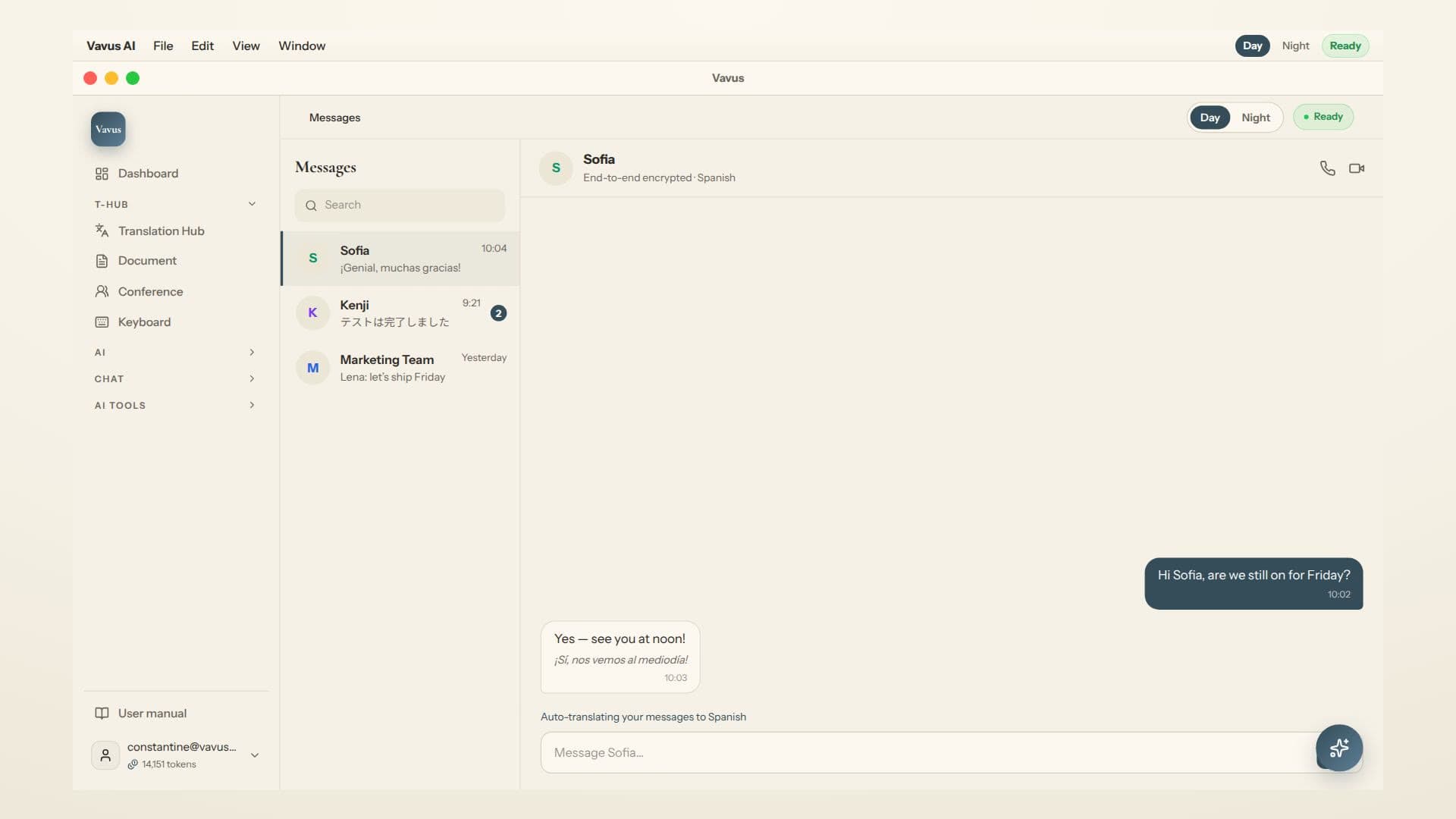
Here is what actually helps, and it is worth being precise about it. Inside the Vavus AI app, you can place or receive a call where each person sets their own language, and the app translates what is said in each direction as the call happens - your father speaks Spanish, you hear English, your reply goes back to him in Spanish. That is real-time translation on a call inside the app. It does not reach into the ordinary cellular network, and it does not listen in on or translate a call placed through your regular phone dialer or your carrier. If the call is not happening inside Vavus AI, Vavus is not part of it. That is a smaller claim than "it translates your phone calls" - and it is the true one, and it is enough to turn a ninety-second call into one where something actually gets exchanged.
The days in between
The call is not the only contact, and it is honestly not even the most frequent kind. Most of what keeps a relationship warm between Sundays is smaller than a call: a photo of dinner with three words under it, a "¿ya comiste?", a twelve-second voice memo, a "llegué bien" sent the moment a plane lands. This is where Vavus Keyboard does the quiet work - type in your language, it goes out in theirs, their reply comes back in yours, inside WhatsApp or Messages or whatever you already use. It does not replace the Sunday call. It fills the six days around it, so the relationship is not running on one minute and fifty seconds a week.
What this does not fix, and why that is fine
Here is the honest part, and it deserves more than a line in fine print. None of this makes you fluent in your father's language, and it does not make him fluent in yours. It will not catch a joke on the first beat - humor runs on timing, and translation adds a half-second of lag that a joke often cannot survive. An idiom about a dog and its tail may cross over as a sentence about an actual dog. A pun just dies, politely, in transit. None of that is a bug a future update fixes. It is what translation is: a workaround for the years of immersion it actually takes to think in someone else's language, not a substitute for them.
Weigh that against what the call already was. For years, most of what got said on a Sunday was performed warmth - "bien, bien," repeated because it was safe, not because it was true. A translated call, imperfect edges and all, where your father actually tells you what the doctor said, or you tell him the real date of the flight, or you finally hear the long version of a story you have only ever gotten in five words - that call is worth more than a fluent-sounding one where nothing real crossed the line. Participation beats silence. A conversation with some rough patches is still a conversation. Ten memorized phrases on a loop, however warmly delivered, is not.
What it costs
If this is landing, there is a companion piece worth reading too: on staying close to family across a bigger generational gap, grandparents and grandchildren on video calls, the whole extended-family shape of the same problem. This post is the small, weekly version of that story; that one is the wider arc it sits inside.
Vavus AI starts at $9.97 a month on web ($9.99 on Apple) for the Personal plan, or pay-as-you-go with tokens. Against the cost of quietly losing the ability to actually talk to your own father, it is not a hard number to justify.
Frequently asked questions
Does Vavus AI translate regular phone calls made through my carrier?
No. This is real-time translation on a call made inside the Vavus AI app itself, where each person sets a language and the app translates as you speak. It does not intercept or translate calls placed over the standard cellular network.
Do both people need the app for it to work?
Yes. Since the translation happens on the call inside Vavus AI, both people need to be on that call in the app for each person to speak and hear their own language.
Is this the same as the video-call translation for grandparents and grandchildren?
It is the same underlying idea, real-time translation so each person uses their own language, applied to an ordinary voice-only call instead of a video one. The companion piece on staying close to family across generations covers the video-call version.
What handles the texts between calls?
Vavus Keyboard. Type in your language, it sends in theirs, and their replies come back in yours, inside the messaging apps already on your phone.
The bottom line: a two-minute call where you actually exchanged something real beats a two-minute call where you both just performed warmth at each other. Translation will not make you sound like a native speaker, and it does not need to. It needs to get one honest sentence from your side of the world to his, and back. Try it at vavusai.com.