You're at a ticket counter in a train station in Kraków, thumbing through the "Getting Around" chapter of a phrasebook looking for something close to "which platform for Warsaw," while the line behind you shifts its weight and someone sighs. You find a phrase, you say it out loud in your best approximation of the phonetic spelling, and the clerk says something back — fast, three sentences, none of which are in the book. You catch nothing. You point at the departure board instead and hope.
That's the actual failure mode of a phrasebook. It's not that the phrases are wrong. It's that a phrasebook is a one-way script for a two-way event. It prepares you to say something. It does nothing for what comes back — and travel is almost entirely made of what comes back: the follow-up question, the price stated once and not repeated, the "actually, that platform changed." A laminated page of pre-written sentences was never built to listen.
What you actually need to say abroad
Strip away the guidebook chapter headings and the situations that actually come up on a trip fall into three kinds.
Transactional: — buying something, ordering food, paying for a taxi, asking how much. These are short, high-frequency, and they need a real answer back (a price, a "we're out of that," a "cash only"). This is where phrasebooks fail hardest, because the reply is unpredictable.
Navigational: — finding your way, asking for help when something's gone sideways (a missed connection, a wrong address, a locked door). These need speed and clarity more than nuance — you need the answer fast, and you need to be understood the first time.
Social: — small talk, thanking someone properly, apologizing for a mistake, complimenting a meal. Nobody needs this to function, technically. But it's the difference between being a tourist who passed through and a guest who was actually there for a moment — and it's usually where the warmest exchanges of a trip happen.
A phrasebook tries to cover all three with the same tool: static text. It's a reasonable attempt. It's just not enough for how any of these actually play out.
For the talking parts: live voice translation
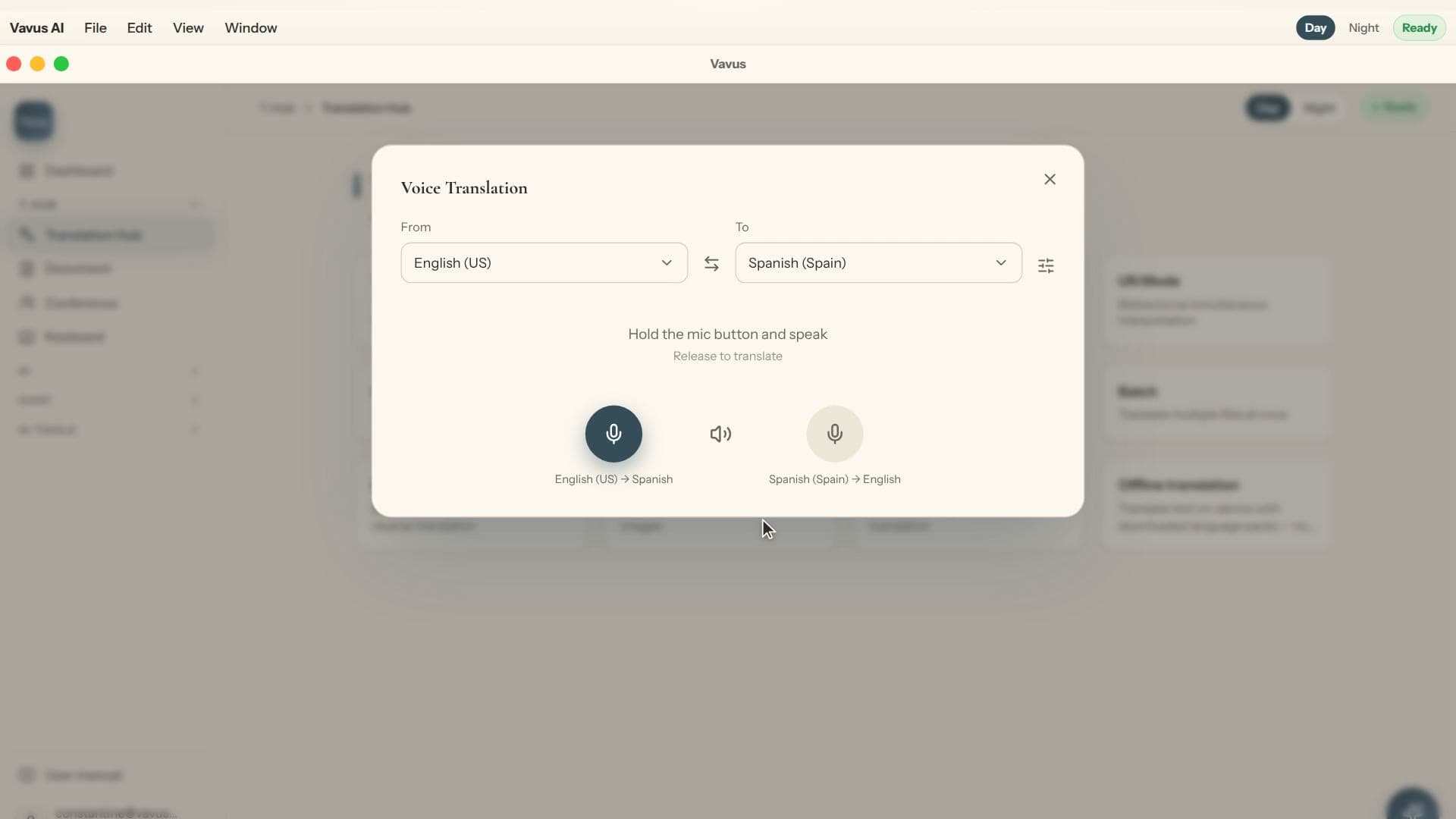
This is what Vavus AI's conversation mode is built for. You speak into your phone, it translates and speaks back in the other person's language, they respond, and it translates that back to you — a real back-and-forth, not a memorized line. It handles all three categories above: negotiating a price at a market stall, asking a stranger which street the hostel is on, telling a host their dinner was the best thing you ate all trip.
Two honest things worth saying plainly. First, conversation mode needs a data or WiFi connection — it's not a magic trick that works with zero signal, and anyone who tells you otherwise is overselling it. If you're somewhere with patchy coverage, plan around that. Second, on coverage: Vavus AI's text translation spans 200+ languages, but live voice translation — the speaking-and-listening kind — covers a narrower set, in the range of 100+ languages. For the languages travelers actually run into most, that's plenty. But if you're headed somewhere with a less common local language, check voice coverage for that specific language before you rely on it as your only plan.
For the typing parts: a keyboard that translates as you go
Not every exchange on a trip is spoken. A lot of it is typed — a message to an Airbnb host about a broken lock, a text to a driver who's running late, a note to hotel front desk asking for an early checkout, a group chat with people back home who don't speak the local language either. This is what Vavus Keyboard is for: you type in your language inside whatever app you're already using — WhatsApp, iMessage, a booking app's chat, email — and it translates as you write, and translates what comes back.
It's a small thing that removes a surprising amount of trip friction. The messages that go wrong on a trip aren't usually the big spoken conversations — they're the short, typed, easy-to-misread ones, sent in a hurry, from a hallway, with bad WiFi and low battery. Getting those right the first time avoids a lot of the "wait, what did they mean by that" spiral that eats an afternoon.
What's actually worth doing before you fly
Be honest with yourself about what preparation buys you here, because not all of it does the same job.
Download the offline language pack: for wherever you're going. This is real and worth doing — but know exactly what it covers. Offline mode is text translation: you can type or paste something and get a translation with no connection. It is not live conversational voice translation; that needs a network to work in real time. Offline is your backstop for a dead zone on a train or a country with limited coverage, not a full replacement for conversation mode.
Learn five to ten phrases yourself, on purpose.: Hello, please, thank you, excuse me, sorry, how much, where is, do you speak English, cheers, goodbye. This isn't redundant with having a translation app — it's a different thing entirely. Saying "thank you" in someone's own language, even badly, even with an accent that makes them smile, does something an app can't: it tells the other person you tried before you reached for a device. People consistently respond warmer to five fumbled words of effort than to a perfectly translated sentence read off a screen. Bring both. The tech handles the conversation; the five words are what you bring as a guest.
Skip the paper phrasebook.: Not because tradition is bad, but because it solves the wrong problem — it prepares you to talk, not to be talked to, and travel is mostly the second one.
Where this doesn't apply
None of this is a substitute for a real interpreter when the stakes are high — a medical situation abroad, a police matter, signing a legal document, anything binding. If you land in one of those, use a professional human interpreter or your embassy's resources, not a translation app. For everything else a trip actually throws at you — buying, asking, thanking, apologizing, chatting — this is exactly the everyday territory these tools are built for.
Frequently asked questions
Do I still need a phrasebook if I have a translation app?
No — a phrasebook only covers what you say, not what comes back, which is most of any real conversation. A live voice translation app covers both directions. Keep 5-10 memorized phrases for warmth and courtesy, but you don't need the paper book.
Does live voice translation work without WiFi or data?
No, live conversation mode needs a connection to translate in real time. What works offline is text translation — typing or pasting something and getting it translated with no signal. Download an offline language pack before you travel as a backup for dead zones, but don't expect it to carry a live spoken conversation.
How many languages does Vavus AI actually cover?
Text translation covers 200+ languages. Live voice translation — speaking and hearing a translated response — covers a narrower set, roughly 100+ languages. Check coverage for your specific destination language before your trip if it's less commonly spoken.
What should I actually memorize before a trip?
Five to ten short phrases: hello, please, thank you, excuse me, sorry, how much, where is, do you speak English, cheers, goodbye. It's not about replacing the app — it's about showing effort, which locals notice and respond to, before you ever open your phone.
The bottom line: the phrasebook's real flaw was never the phrases — it was assuming travel is something you can script in advance. It isn't. Live voice translation handles the conversation as it actually happens, a translating keyboard handles the messages in between, an offline pack is a smart backup for dead zones, and a handful of memorized words still buys you something no app can: a moment of genuine effort with a stranger. Try it at vavusai.com.