Everyone who has traveled has done it: standing in front of a menu board covered in a script you can't read, the line moving, the server waiting, and you point at whatever looks least alarming — a photo, a word that seems familiar, the dish two tables over that smelled good. Sometimes it works out fine. Sometimes what arrives is a plate of something you genuinely did not want: an organ you weren't expecting, a portion sized for four people, a dish so spicy you're reaching for every glass of water on the table.
Most of the time this is a funny story you tell later. It's part of the texture of traveling somewhere new. But "point and hope" is a strategy built entirely on luck, and luck is not something you want to be relying on for every meal of a trip — and it's definitely not something to rely on if what you're avoiding isn't food you don't like, but food that could put you in a hospital. That part gets its own section below, not a footnote.
Reading the menu instead of guessing at it
The first real fix is simple: stop guessing and actually read the menu. Vavus AI's camera translation lets you point your phone at a menu board, a printed sheet, or a chalkboard special and see it translated in front of you — not word-by-word gibberish, but a menu you can actually read and choose from like a local would. It works whether it's a full laminated menu at a sit-down restaurant or a single handwritten board outside a street stall.
This alone solves the biggest share of the problem, because most of what goes wrong with point-and-pray ordering isn't a complicated question — it's simply not knowing what a dish is. Once you can read "grilled octopus with lemon" instead of staring at three unfamiliar words, you're choosing a meal instead of drawing one from a hat.
The part a photo can't answer
A translated menu tells you what a dish is called. It doesn't tell you how spicy the server's definition of "mild" actually is, whether tonight's fish special is any good, or whether the kitchen can leave out an ingredient. That's a conversation, not a static page — and it's exactly what live voice translation is for.
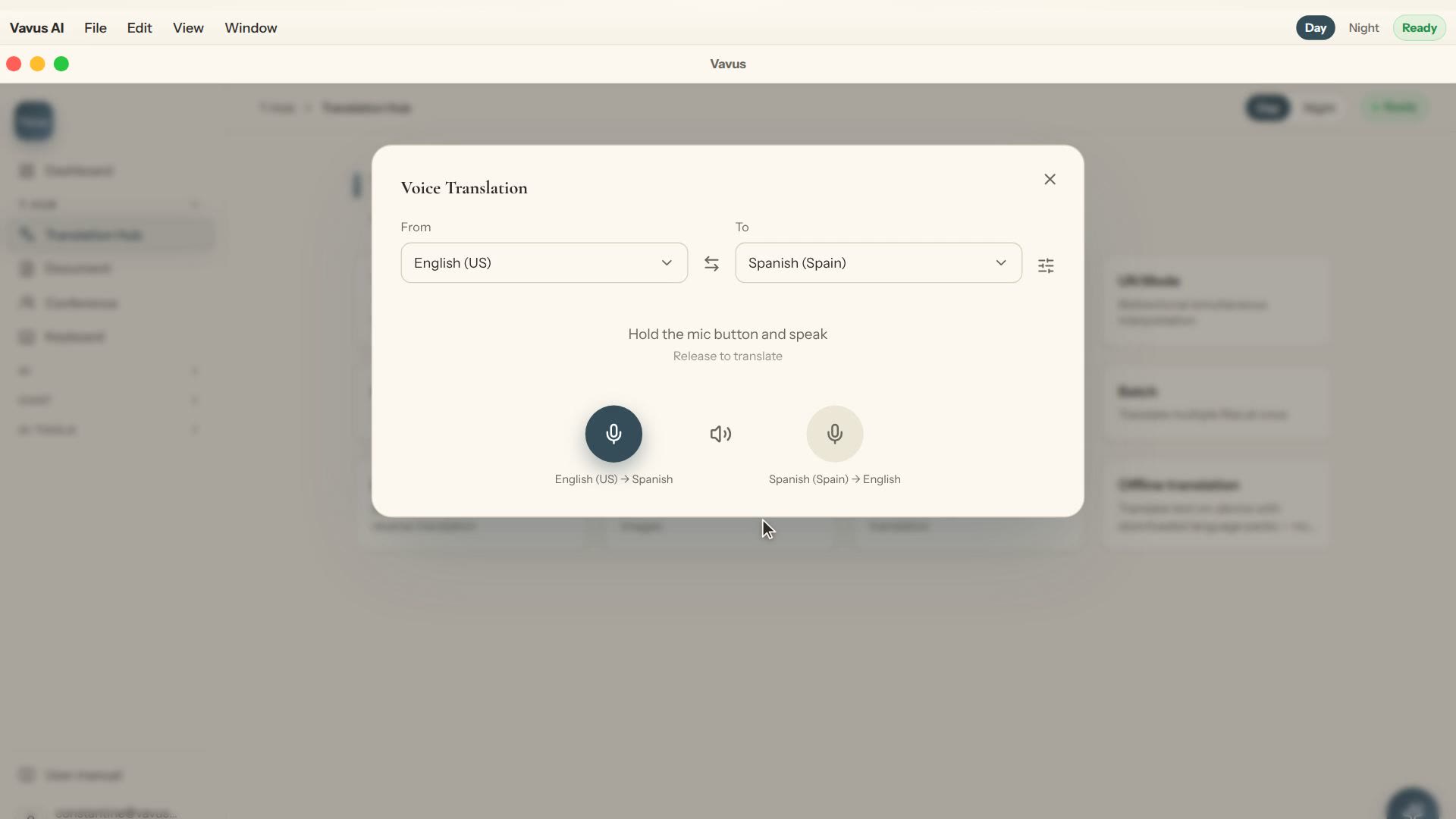
Vavus AI's conversation mode lets you actually talk to your server: ask what they'd recommend, ask how spicy a dish really runs, ask what's in a sauce you don't recognize, ask if something can be made without the shellfish or the peanuts. You speak, they hear it in their language, they answer, and you hear the answer in yours — a real back-and-forth instead of a phrasebook sentence with no way to understand the reply.
Where this stops being a guessing game: allergies
Everything above makes ordering food abroad easier and less stressful. For most people, most of the time, that's the whole story. But if you or someone you're traveling with has a real food allergy, this section matters more than anything else in this post, so it gets said plainly instead of buried as a caveat at the end.
Food allergies are common enough that organizations like FARE (Food Allergy Research & Education) publish ongoing figures on how many people in the U.S. alone live with one — a meaningful share of the population, spanning both adults and children, and for some of them a reaction isn't uncomfortable, it's life-threatening. If that's your situation, or the situation of someone you're traveling with, here is the honest advice: a translation app is a helpful backup, not the primary safety tool. The thing that should be doing the heavy lifting is a professionally translated allergy card — a printed card stating the specific allergy clearly and unambiguously in the local language, ideally reviewed by a professional translator or a native speaker familiar with food and medical terminology, that you hand directly to kitchen staff.
Why a card and not just an app in the moment: a card is unambiguous, doesn't depend on a signal or a battery, can be handed straight to the kitchen and not just the server, and removes any risk of a mistranslated word in a live exchange when the cost of a mistake is severe. Vavus AI's live voice and photo translation are genuinely useful for the everyday parts of an allergy-aware trip — asking a server general questions, double-checking a translated ingredient list, reading a packaged label — but for someone with a severe or life-threatening allergy, they support the safety plan. They are not the safety plan. That's the honest line, and it's worth planning for before you fly, not figuring out at the table.
A few notes on ordering abroad
-In many cultures, asking your server what they'd recommend is not just accepted — it's often preferred over rattling off a long list of specific requests. It signals trust and usually gets you the kitchen's best dish that night.
-Portion sizes and course structures vary a lot. What looks like a small appetizer on a translated menu can be a full meal, and vice versa.
-A little effort with basic words — please, thank you, this is delicious — tends to get warmer service than a flawlessly translated order delivered with no eye contact.
Frequently asked questions
Can I just point my camera at a menu and get a translation?
Yes. Vavus AI's camera translation reads a menu board, printed menu, or handwritten special and translates it so you can read and choose from it directly, instead of guessing from unfamiliar words or photos.
How do I ask a server questions if I don't speak the language?
Use live voice translation, also called conversation mode. You speak into your phone, the server hears it in their language, they respond, and you hear the translation — a real conversation, useful for asking about spice level, recommendations, or whether a dish can be modified.
Is a translation app safe to use for food allergies?
It's a useful backup, not a substitute for the real safety tool. For anyone with a severe or life-threatening allergy, a professionally translated allergy card — ideally reviewed by a professional — that you hand directly to kitchen staff is the standard practice. A translation app is genuinely helpful for the everyday parts of an allergy-aware trip, but it should support that plan, not replace it.
What if the restaurant has no WiFi or signal?
Live voice translation needs a connection to work in real time. Photo translation of a menu can work with limited connectivity depending on your setup, but it's worth planning around dead zones — download what you can in advance, and for anyone with an allergy, the printed card works with zero signal at all, which is one more reason it's the tool you actually want in your pocket.
The bottom line: pointing at a menu and hoping is a fine story for the meals that turn out fine. It's not a plan you want to be running on for every meal of a trip, and it's genuinely not the right approach when a real allergy is involved. Read the menu instead of guessing at it, ask your server the questions a photo can't answer, and if the stakes are serious, carry a professionally translated allergy card as your primary safeguard. Try it at vavusai.com.